The first basket of eggs I ever brought inside that had a blue one in it — I just stood at the counter and stared at it for a moment, the way you do when something ordinary suddenly looks like it belongs somewhere else entirely. That was 2014, my first Easter Egger pullet, and I’ve kept at least one blue or green layer in my flock every year since.
If you want colored eggs in your basket, you have more options than you might think — and a few important things to understand about what drives egg color, why it’s not always consistent, and which breeds will actually deliver reliably versus which will leave you with a hen that lays the same pale tan egg every single day despite the catalog photo that suggested otherwise.
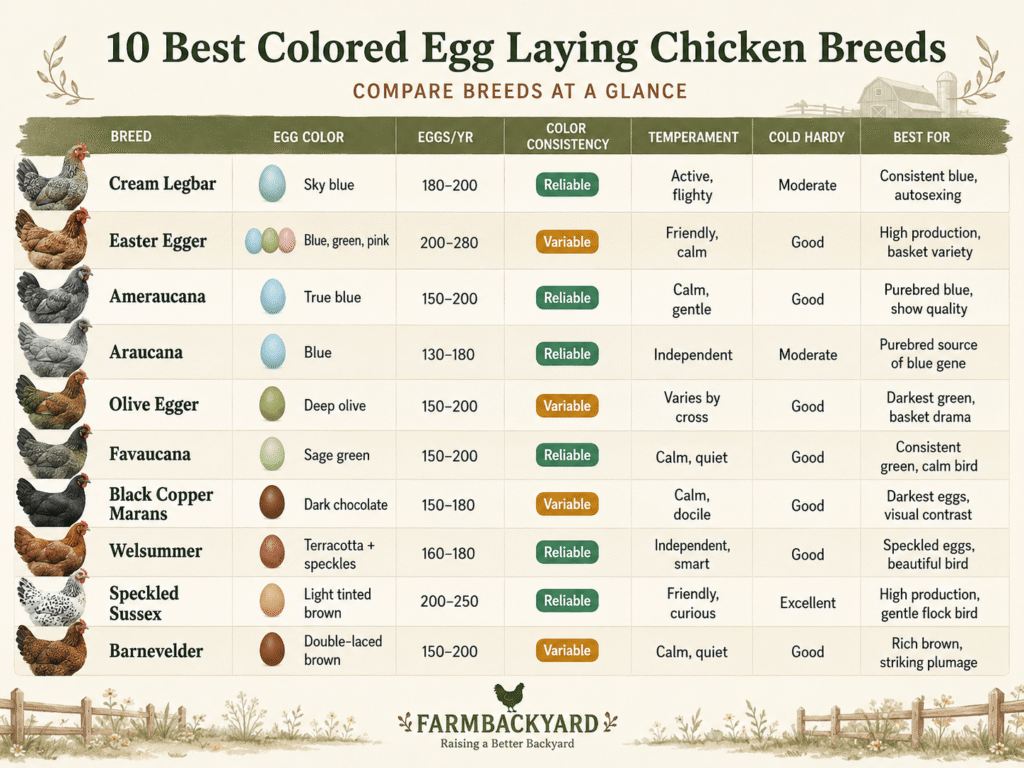
The best colored egg laying chickens are Cream Legbar (reliable sky blue, 180–200 eggs/yr), Olive Egger (deep olive-green, 150–200 eggs/yr), Marans (dark chocolate, 150–180 eggs/yr), Easter Egger (blue, green, or pink, 200–280 eggs/yr), and Welsummer (terracotta brown with dark speckles, 160–180 eggs/yr). For the most colorful basket, keep three or four of these together.
Breed Comparison Table
Why Egg Color Happens — and Why It Sometimes Doesn’t
Before you pick a breed, it helps to understand that egg color is a pigment deposited on the shell during its formation in the hen’s oviduct — and it’s determined entirely by genetics, not diet, stress level, or the color of the hen’s feathers. Blue and green eggs get their color from a pigment called oocyanin, which penetrates the shell all the way through. Brown eggs get their color from protoporphyrin, which coats only the outside — which is why if you crack a brown egg, the inside of the shell is white.
This matters practically because blue egg color is consistent and doesn’t fade across a laying cycle, while brown egg pigment absolutely does. My Welsummers lay gorgeous dark speckled terracotta eggs at the start of a lay cycle and noticeably lighter eggs by the end of a clutch. My two Cream Legbars lay the same sky-blue color on day one as day fifty. If you want a breed where the egg color is exactly what you expect every single day, choose a blue-egg layer.
The other thing nobody tells you up front: “Easter Egger” is not a breed. It’s a marketing term for any chicken carrying the blue-egg gene without meeting the breed standard of a true Ameraucana or Araucana. That’s fine — Easter Eggers are excellent, productive, friendly birds — but their egg color is genuinely unpredictable until the first egg drops. I’ve had Easter Eggers lay pale blue. I’ve had them lay sage green. I once had one lay what I can only describe as a dusty pink that made my daughter cry happy tears. I’ve also had one lay a perfectly ordinary tan egg for three years straight, which was a genuine disappointment.
Every spring when the hatchery catalogs show up, the question I field most often from neighbors is about colored eggs — and this is the part I make sure to explain before anyone orders.
Cream Legbar: The Best Reliable Blue Egg Layer
I’ve kept Cream Legbars for three years now — two of them are in my current flock — and they’ve changed what I thought I knew about blue eggs. Before them, I was relying on Easter Eggers for my blue, which meant hoping. The Legbars removed the guesswork entirely.
Cream Legbars are an autosexing breed, which means you can identify males and females at hatch by their down color — a practical advantage when ordering from a hatchery if you’re in a no-rooster zone. The hens are active, slightly flighty, and independent in a way that makes them better suited to a free-range or large-run setup than a tight coop. Mine range the back quarter of the yard most of the day and are the last ones in at dusk.
Egg production runs 180–200 per year in my experience — consistent but not exceptional. The eggs themselves are a reliable sky blue, medium-sized, and the color doesn’t fade across the laying cycle the way brown eggs do. The one honest caveat: Cream Legbars are not calm lap chickens. My two are skittish compared to my Black Sex-Links, and they’ve never fully warmed to being handled. For a family flock where kids are involved, that’s worth factoring in.
Easter Egger: Best for Production and Basket Variety
If you want the most eggs and the most color variety in a single breed, Easter Eggers are the pragmatic answer. At 200–280 eggs per year depending on the individual, they’re among the highest-producing colored-egg layers you’ll find — numbers that compete with production breeds like ISA Browns on a pure output basis.
The personality is also reliably good. In twelve years of keeping chickens, Easter Eggers have been among the friendliest birds I’ve had. They’re curious, adaptable, and generally tolerant of being handled, which makes them good choices for a family flock or a mixed pen with newer keepers.
The caveat I already noted stands: you do not know what color egg you’ll get until she lays. Hatcheries describe this as a feature, and for a basket-variety perspective it genuinely is. But if you’re building a flock specifically to have blue eggs and you order six Easter Eggers, there’s a real chance two or three of them lay green, one lays blue, and one lays tan. I’ve watched that exact scenario play out with a neighbor who was frustrated by it. The solution is to order at least one Cream Legbar or Ameraucana alongside your Easter Eggers if a guaranteed blue is important to you.
Ameraucana vs Araucana vs Easter Egger: What’s the Actual Difference?
This is the question that generates more confusion at the feed store than any other, so let me be direct about it.
Araucana is the original South American breed that carries the blue-egg gene. They’re rumpless (no tail), tufted (feather tufts near the ears, not a beard), and genuinely difficult to breed well — a lethal gene issue means double-tufted embryos often don’t survive to hatch. Production is lower, around 130–180 eggs per year. They’re rare, challenging, and mostly kept by dedicated breeders.
Ameraucana was developed from Araucana stock in the United States specifically to remove the lethality problem. They have beards and muffs instead of tufts, a proper tail, and come in recognized color varieties. True Ameraucanas lay reliable blue eggs, average 150–200 per year, and are calm, well-tempered birds. The problem is that actual Ameraucanas are rarer than most people realize — what most hatcheries sell as “Ameraucana” is usually an Easter Egger.
Easter Egger is anything carrying the blue-egg gene that isn’t a recognized breed. Most hatchery “Ameraucanas” are Easter Eggers. That’s not a problem — Easter Eggers are great birds — but if you want a true Ameraucana, you need to buy from a breeder who shows the breed, not from a hatchery catalog.
I keep two true Cream Legbars and have kept Easter Eggers for years. I’ve never kept a true Ameraucana, though I’ve come close to ordering from a breeder more than once. If the distinction matters to you for showing or breeding, source carefully.
Black Copper Marans: The Chocolate Egg Question
When I first added Marans to my flock in year eight, I understood intellectually that they laid dark brown eggs. What I didn’t understand was how dark. The first egg one of my hens dropped was so deeply pigmented — a true chocolate brown, almost burgundy — that I brought it inside and held it next to a regular brown egg just to look at the contrast. It looked like it belonged to a different animal.
Black Copper Marans are the gold standard for chocolate eggs, but they come with a few honest caveats. First, the depth of color varies significantly between individual hens and across a laying cycle. The darkest eggs come early in the cycle and lighten as the cycle progresses — a hen who lays a stunning chocolate egg in October may be laying a regular dark brown egg by February. If you want to verify depth before purchasing, ask the breeder for egg samples rated on the Marans egg color chart (scale 1–9; aim for a hen from a line that consistently produces 6+ eggs).
Second, Marans are not prolific layers. At 150–180 eggs per year, they trail Easter Eggers and Legbars by a meaningful margin. If you’re running a flock primarily for production and adding one Marans hen for the drama of a dark egg in the basket, that’s a reasonable approach. Running a full Marans flock and expecting high production is a mismatch of expectations.
I had two Black Copper Marans for three seasons. I loved them. I also found them quieter and calmer than my Welsummers, which I hadn’t expected.
Welsummer: The Speckled Egg Nobody Talks About Enough
My two Welsummers are in my current flock, and their eggs are the ones that visitors always pick up first. Dark terracotta, often with deep brown speckles — the kind of egg that looks like it was painted. Welsummers don’t get the same attention as Marans for dark eggs, but their distinctive speckled pattern is something no other common breed replicates.
The production numbers are honest at 160–180 eggs per year — not exceptional, but respectable. The breed is independent and smart in a way that makes them entertaining to watch but occasionally stubborn to manage. Mine are the first birds to figure out where a gap in the fence is. They’re also good foragers and hold their own in a mixed flock without being aggressive.
One thing worth knowing: the speckles on Welsummer eggs are a surface pigment that can actually be rubbed off when wet or freshly laid. I learned this when my daughter was helping collect eggs in the rain one year and came inside holding what she thought was a plain brown egg — she’d wiped the speckles off. The egg is still beautiful, the speckles just aren’t permanent the way the base color is.
Olive Eggers: How to Get the Darkest Green Eggs
An Olive Egger is a cross between a blue-egg layer (Cream Legbar, Ameraucana) and a dark brown-egg layer (Marans, Welsummer). The blue pigment plus the dark brown overlay produces olive green — and the darker the brown-egg parent, the deeper the olive. A Cream Legbar crossed with a Black Copper Marans produces a significantly deeper olive than the same cross with a lighter-brown-egg breed.
I haven’t kept Olive Eggers in my own flock, but Sandra next door has run two F1 Olive Egger hens for the past two years alongside her Barred Rocks, and the eggs are genuinely striking — a deep khaki-olive that sits between green and brown in a way that’s hard to describe until you see it. Her production numbers have been around 160–180 eggs per year from those birds.
The important distinction is F1 versus F2. First-generation Olive Eggers (one blue-egg parent, one dark brown-egg parent) produce the most consistent olive color. Breeding two Olive Eggers together produces a second generation with much more variable color — some eggs will be lighter, some greener, some nearly brown. If consistent deep olive is the goal, stick to F1 birds.
Building the Most Colorful Egg Basket: What to Actually Keep Together
If you want a basket that covers the full spectrum — sky blue, sage green, deep olive, chocolate brown, speckled terracotta, and rich tinted brown — here’s the combination I’d recommend for a small backyard flock of eight to twelve birds:
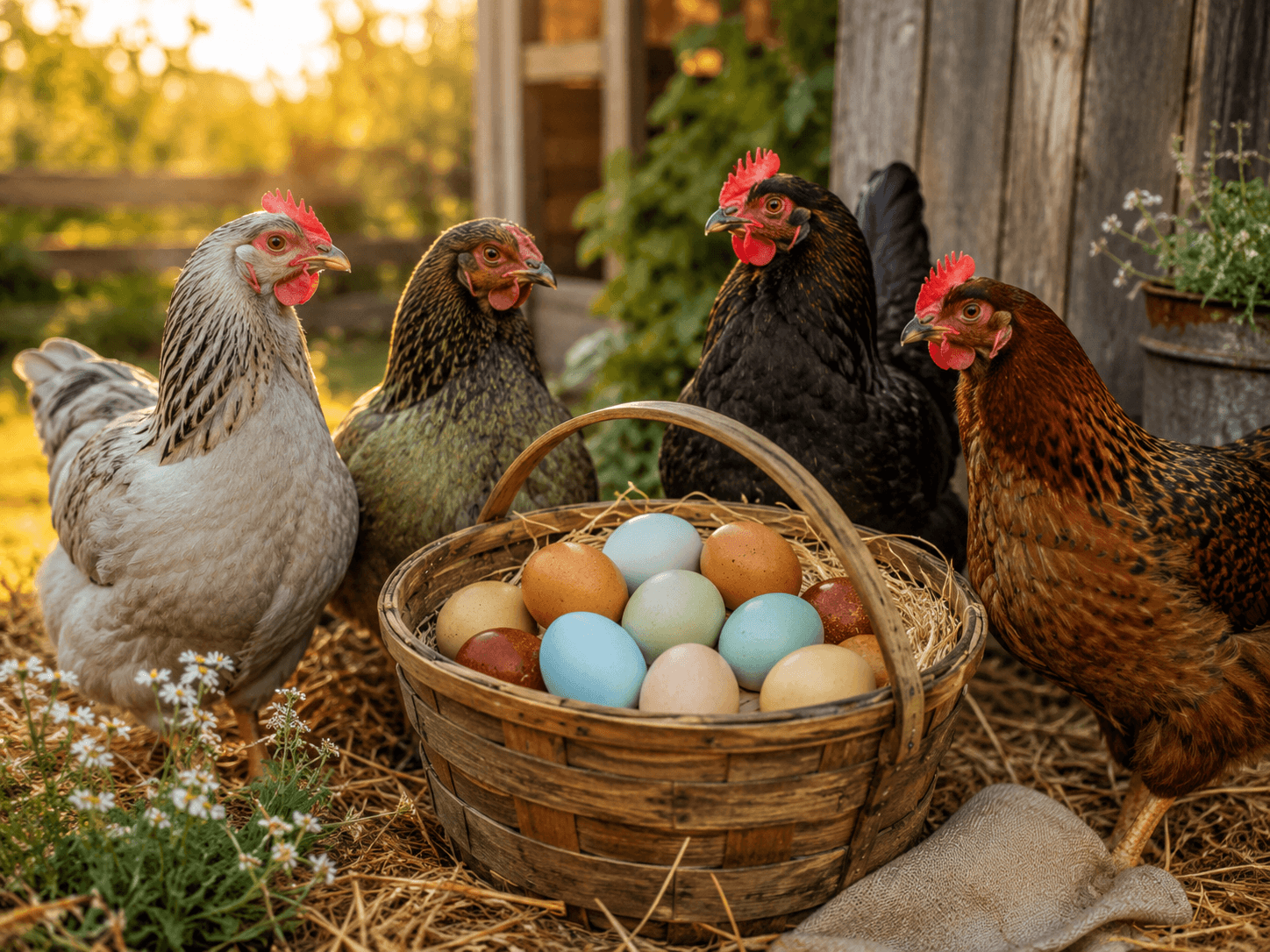
Two Cream Legbars for reliable blue. Two Easter Eggers for green and variety (accept the uncertainty). One Black Copper Marans for the chocolate anchor. Two Welsummers for the speckled terracotta. Two Speckled Sussex or Barnevelders for rich brown. One Olive Egger for the deep green bridge between blue and chocolate.
That’s ten birds, a basket that looks like it was arranged for a photograph, and a production rate that gives you roughly 7–9 eggs per day at peak — enough for a family of four with plenty to share. All of these breeds coexist well in a mixed flock. None of them are aggressive toward the others in my experience, and the temperament spread — from the independent Welsummers to the friendly Easter Eggers — makes for a flock that’s interesting without being difficult.
Situational Guide: Which Colored Egg Layer Is Right for You?
If you want the most reliable blue egg every single day → Cream Legbar. Non-negotiable consistency, autosexing at hatch, around 190 eggs per year.
If you want the highest egg production from a colored-egg layer → Easter Egger. Up to 280 eggs per year, friendly temperament, accept that color is a surprise.
If you want the darkest chocolate egg and production is secondary → Black Copper Marans. Source from a line rated 6+ on the Marans color chart. Expect 150–180 eggs.
If you want eggs with speckles and an independent, interesting bird → Welsummer. Reliable terracotta speckles, good forager, 160–180 eggs per year.
If you want the deepest olive-green egg possible → F1 Olive Egger crossed from a Cream Legbar hen and a Black Copper Marans cockerel. Do not use F2 birds if color consistency matters.
If you want a calm, gentle bird that lays a reliably green egg → Favaucana (Faverolle x Ameraucana cross). Consistent sage-green color, calm temperament, good cold-hardiness.
If you want a truly purebred blue-egg layer for showing → Source a true Ameraucana from a reputable breeder who shows the breed. Not a hatchery “Ameraucana.”
If you want the most colorful basket from the fewest breeds → Cream Legbar + Easter Egger + Welsummer + Marans. Four breeds, six colors covered, all manageable temperaments.
Colored Egg Chicken Questions Answered
What chicken lays the bluest eggs?
Araucana and Cream Legbar lay the most reliably vivid blue eggs. Ameraucana lays a true blue that’s slightly softer in tone. Easter Eggers can lay blue but the shade varies unpredictably by individual hen. If consistent, deep sky-blue is the goal, Cream Legbar is the practical choice — reliable color, autosexing, and around 190 eggs per year.
What is the rarest egg color from a chicken?
Pure white and very dark chocolate brown are both uncommon in backyard flocks, but the rarest egg color most backyard keepers encounter is a deeply speckled chocolate from a Black Copper Marans rated 8–9 on the Marans color scale — genuinely difficult to produce consistently. Pink or lavender-tinted eggs from some Easter Egger crosses are also unusual enough that many longtime keepers have never seen one.
Do colored eggs taste different from white eggs?
No. Egg shell color has no effect on flavour, nutrition, or yolk quality. Those are determined by diet, age of the hen, and whether she free-ranges. A Cream Legbar hen on commercial layer feed will produce a pale-yolked, relatively mild egg. That same hen ranging on pasture and eating insects will produce a deep-orange-yolked egg that tastes richer. The shell color is cosmetic.
Will an Easter Egger always lay colored eggs?
No, and this is the most important thing to understand before purchasing. Easter Eggers carry the blue-egg gene but its expression is variable. Most Easter Eggers lay some shade of blue, green, or sage. Some lay a warm pink or cream. A small percentage lay a plain tan egg with no blue pigment expression at all. You will not know what color your Easter Egger lays until her first egg.
Can two colored-egg breeds produce different colored eggs when crossed?
Yes — this is exactly how Olive Eggers are made. Crossing a blue-egg layer with a dark-brown-egg layer produces olive green in the first generation. Crossing two Olive Eggers produces unpredictable variation in the second generation. The principle applies across other crosses too: a Cream Legbar rooster over Welsummer hens produces a lighter olive than a Marans cross would.
Do Marans eggs stay dark all year?
No. Black Copper Marans and other dark-egg Marans hens lay their darkest eggs at the start of a lay cycle and progressively lighter eggs as the cycle continues. After a molt and a rest period, the color resets and the next cycle begins dark again. This is why egg color photos from Marans breeders should be taken as peak-cycle examples, not daily averages.
What’s the difference between Ameraucana and Easter Egger?
Ameraucana is a recognized breed with a defined standard — beards, muffs, slate-blue legs, specific color varieties, reliable blue eggs. Easter Egger is any chicken carrying the blue-egg gene that doesn’t meet that standard. Most hatchery birds sold as “Ameraucana” are Easter Eggers. Both lay blue or green eggs, but only a true Ameraucana from a breeder who shows the variety will breed consistently to type.
There’s a particular moment in late April, when the days are long enough again and the whole flock is in full lay, and I come inside with a basket that has a sky-blue Legbar egg on one side and a dark speckled Welsummer egg on the other and something green from an Easter Egger in the middle. I’ve seen it probably eight springs in a row now and it still makes me stop for a second at the kitchen counter. The eggs themselves taste the same as they always do. It’s just that some mornings, the ordinary things are worth looking at.